
Every so often something happens that makes you pause, smile, and feel quietly grateful for the journey that brought you here. Recently, I received one of those moments.
I’ve been invited to serve as a judge for the True Crime Awards 2026, and I can honestly say it feels like a real honour.
Over the years, my work as a true crime author has brought me into a remarkable community of people who care deeply about stories - not just the dramatic headlines, but the human truths behind them. From readers who reach out to share their own experiences, to journalists, podcasters, documentary makers and fellow writers who dedicate themselves to telling these stories with integrity.
Having spent time at CrimeCon as an author, speaker, and compère, I’ve had the privilege of meeting many of these people in person. There is something very special about that gathering. It’s not simply about fascination with crime; it’s about understanding it, learning from it, and giving voice to stories that might otherwise remain unheard.
Many people assume true crime is simply about shocking events. But those of us working in this space know the reality is very different. Done properly, true crime is about responsibility. It requires meticulous research, careful fact-checking, and a deep respect for the people whose lives have been affected. Behind every case are real families, real trauma, and real consequences. Telling those stories means navigating legal complexities, ethical boundaries, and emotional realities with care and sensitivity.
That’s why the True Crime Awards matter. They exist to recognise the extraordinary work being done across television, podcasts, journalism, and publishing - creators who go beyond the sensational and commit to telling these stories properly. The awards celebrate those who combine compelling storytelling with accuracy, empathy, and integrity.
As judges, we’ll be looking at many aspects of the work submitted: originality, production quality, depth of research, ethical responsibility, and the way each creator handles sensitive subject matter. In other words, we’re looking for storytellers who get it right.
For me personally, being part of this process feels particularly meaningful. My own writing grew from deeply personal experience - from a story I never expected to tell, but one that ultimately helped others recognise manipulation, coercive control, and the psychology behind deception.
Since publishing The Bigamist and later The Psychopath, I’ve heard from countless readers who saw pieces of their own lives reflected in those pages. That’s the real power of storytelling. When truth is shared with courage and care, it doesn’t simply inform - it empowers. And that is exactly what the best writers and creators do. They shine a light where there was darkness. They ask difficult questions. They treat truth with the seriousness it deserves.
To now play a small role in recognising that work is both humbling and genuinely exciting.
I’m very much looking forward to discovering the incredible stories, investigations, and productions that have been created across the genre this year - and celebrating the people who dedicate themselves to telling them well. Because behind every great piece of true crime storytelling is something more important than intrigue. There is truth.
And truth, when handled with care, has the power to change lives.
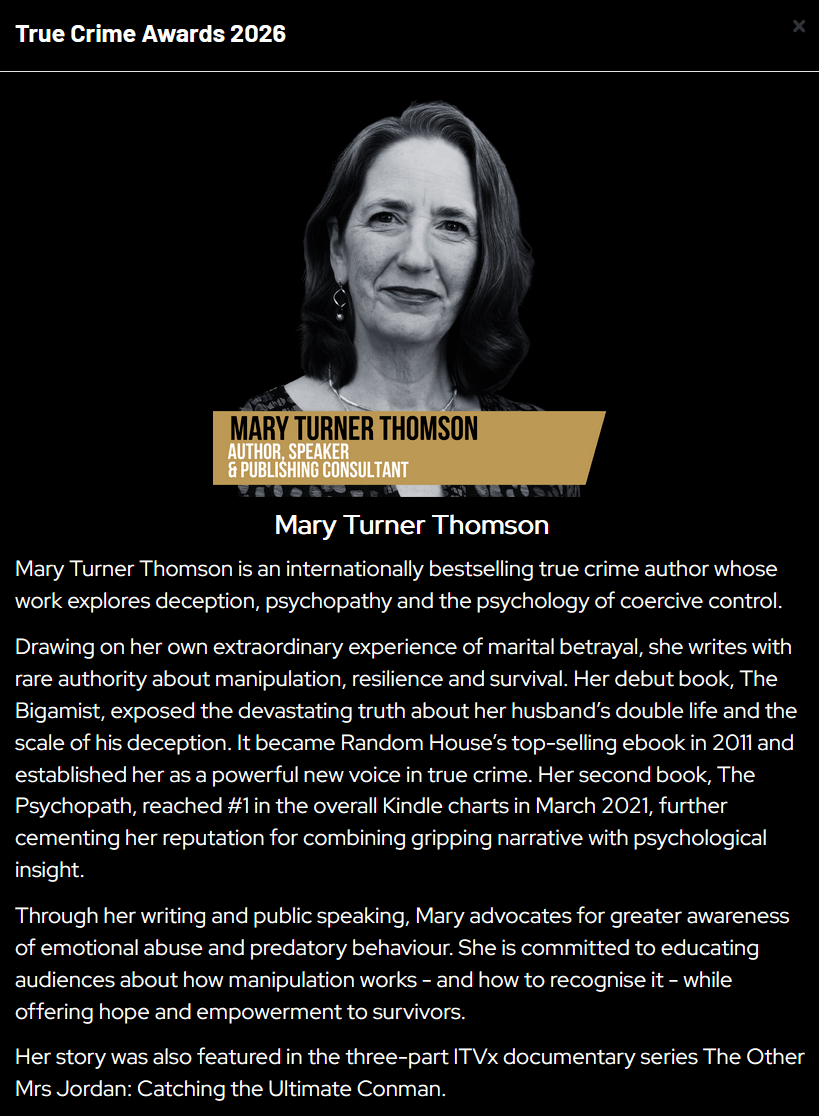
Mary Turner Thomson is an international best-selling author, writing coach and publishing consultant. She specialises in helping people tell their stories, and is passionate about not victim shaming – including not victim shaming ourselves. She’s also the author of two true crime memoirs and a novel about resilience.